
Lift Systems
Special Capacity People’s Lifts
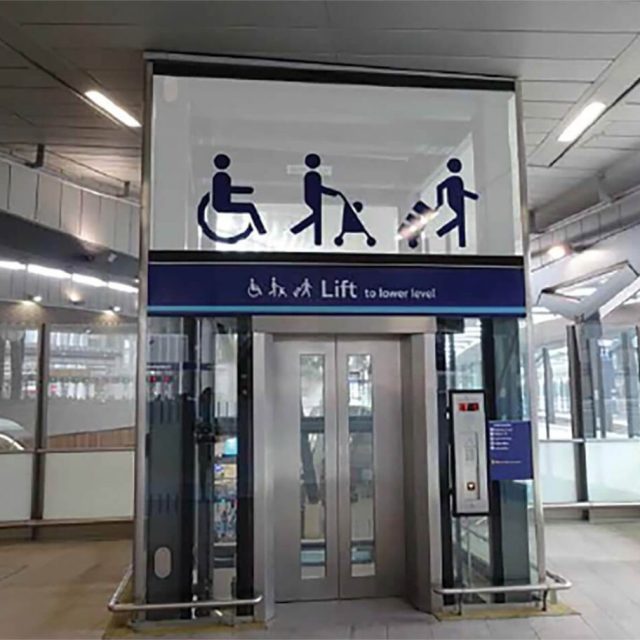
This range began with a question from a client. In 2020, a major player in the railway operator industry, asked SERAPID for safe, reliable access to the rail network for all passengers. SERAPID was a heavy-duty lift specialist. What came back was a new product line: a passenger lift with a low payload, built on the same rigid chain drive as the 60-tonne truck lifts, and built for exactly the environment that defeats conventional station lifts.
Designed for the environment, not just the load
A station lift fails for reasons that have nothing to do with its rated capacity. It is outdoors or near enough. It is used constantly and not gently. It is a long way from a maintenance depot, and every hour it is out of service is an hour the station is not step-free. The rigid chain drive is sturdy, purely mechanical and needs only minimal maintenance, which reduces downtime rather than merely making it easier to fix.
Payload and speed
| Configuration | Payload | Speed |
| Standard duty | 1,250 kg | 0.63 m/s |
| Emergency operation (bespoke case) | 450 kg | 0.38 m/s |
The second row is the interesting one. It is not a smaller model — it is the same lift continuing to work after a component has failed, at reduced payload and reduced speed, so that passengers still reach the platform. For an operator, that is the difference between a degraded service and a closed station.
The lift is built from three main components: the drive system, the guide structure and supporting frame, and optional counterweights. That modularity is what makes the compact mechanical drive retrofittable into existing shafts with the building fabric practically unaffected in operation — and it is what allows the same product to be adapted across the very wide variety of platform arrangements found on a national rail network.
The lifting columns are continuously lockable and position within the millimetre range without rebound, irrespective of changing or eccentric load distribution. No locking mechanism intervenes, no re-levelling occurs and no compensation system is fitted — because none is needed. For an accessibility lift, where a step at the landing threshold defeats the entire purpose of the installation, this is the specification that matters most.
Alongside the station product, SERAPID’s Vertical LinearBeam range addresses domestic and public accessibility and service lift requirements, compliant with the Machinery Directive 2006/42/EC, the Lift Directive 2014/33/EU, EN 81-20:2014 and EN 81-41. Modules arrive ready to install, which shortens the on-site programme for both new build and retrofit.
At the client’s request, an extensive test rig was built at SERAPID’s French headquarters so the new design could be put through rigorous testing before installation. The precedent was set at interlift 2019, where a full-scale SERAPID lift ran approximately 2,500 cycles over four days without interruption and without lubrication.
Frequently asked questions
The standard duty is 1,250 kg at 0.63 m/s. A reduced-duty emergency mode of 450 kg at 0.38 m/s was developed so that passengers can still be brought to the platform after a component failure.
Yes. The purely mechanical drive is compact and modular, which makes space-saving retrofit into existing shafts practical with the building fabric practically unaffected in operation.
The lift meets the requirements of the EN 81 standard series. The related Vertical LinearBeam accessibility range is compliant with the Machinery Directive 2006/42/EC, the Lift Directive 2014/33/EU, EN 81-20:2014 and EN 81-41.
Because the failure modes in public and transport environments are about availability, not capacity. A purely mechanical drive with minimal maintenance requirement, millimetre positioning without re-levelling, and no hydraulics keeps the lift in service.
The design was developed specifically for the demanding conditions of railway stations and is built to withstand the special requirements of public places.
Contact SERAPID to define your scope of supply
Discuss your lift project with our engineers and choose the right level of support, from Drive Train to fully commissioned Turnkey Lift.