
Use Case
Defence & Naval
On a vessel, volume is the scarcest resource there is. Every cubic metre given to machinery is a cubic metre not given to capability, and every system needing regular maintenance needs access — which needs more volume again. A lift running between decks is competing for space against everything else the ship exists to do.
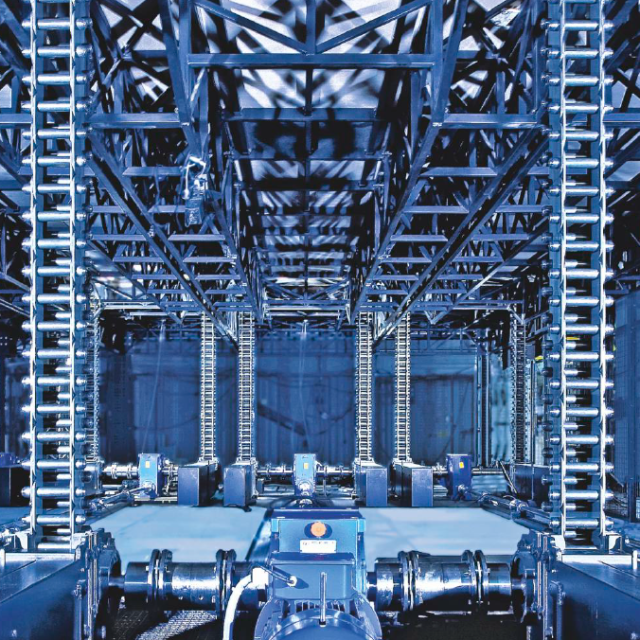
Rigid Chain Technology earns its place there by storing flat. A column with metres of travel coils into a magazine a fraction of its extended length, so the mechanism occupies space proportional to what it stores rather than to what it reaches.
Where lifts appear
| Application | The constraint |
| Stores and provisions lifts between decks | Very restricted volume; no machine room possible |
| Weapons and munitions handling lifts | Absolute reliability; no fluid; controlled, repeatable positioning |
| Vehicle and equipment lifts on deck | Heavy, off-centre loads on a moving platform |
| Dockyard and base goods lifts | Heavy freight in buildings often decades old |
| Dockyard truck and vehicle lifts | 10–60 t vehicles where no ramp exists |
| Hangar and workshop lifts | Retrofit into existing structures without disruption |
The characteristics that matter in this market
- Volume efficiency — long travel from a magazine a fraction of the stroke
- No hydraulics, which removes a fire load, a leak path and a set of pressurised lines to route
- No machine room, in an environment where there is nowhere to put one
- Loads resolve downward rather than hanging from structure above
- No differential movement under an eccentric or shifting load
- Purely mechanical construction, minimal maintenance, guaranteed to 1 million cycles
- Proven in corrosive and extreme-temperature service
Adjacent proven capability
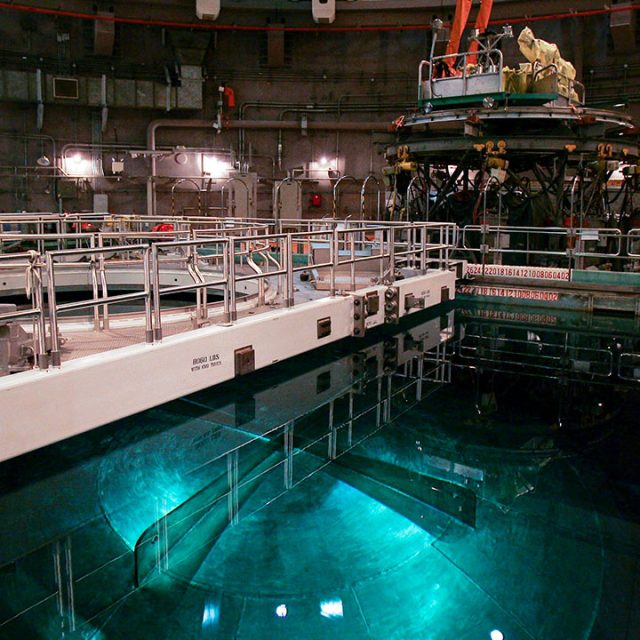
Where a programme needs assurance and this sector cannot supply its own references, the closest published analogues are worth citing directly. Nuclear demonstrates lifts qualified for safety-related duty in severely constrained, contaminated environments with plant-length service lives. Heavy industry demonstrates survival under heat, dust and shock. Infrastructure demonstrates availability in assets that cannot close. The requirement sets overlap almost completely.
How these projects run
Defence lift work is engineered rather than catalogued, and SERAPID supplies engineering, design integration, installation, commissioning and field technician services alongside the equipment. In a programme environment that scope usually matters more than the product specification, because it determines who carries the integration risk.
Frequently asked questions
Because it stores flat. The retracted chain occupies a fraction of the volume of its travel, so a lift serving several decks is possible in a space that could not accommodate a hydraulic ram or a traction machine of equivalent reach.
Considerably. It removes a fire load, a leak path, a maintenance burden and a set of pressurised lines that would otherwise have to be routed through the hull.
Yes. No machine room and no borehole are required, and the shallow pit and compact drive make installation into older estate buildings far less disruptive than a conventional lift.
Engineering, design integration, installation, commissioning and field technician services worldwide.
Contact our engineering team
Defence and naval lift work is engineered rather than catalogued. Discuss your programme requirements with our engineering team.