
Use Case
Heavy Industry & Metals
Steel plants destroy equipment. Heat, scale, dust, vibration and shock loading shorten the life of anything with a seal, a sensor or a tight tolerance — and in a lift, the components that fail first are usually the ones added to compensate for a technology that could not hold position on its own.
The heavy goods lift range exists for exactly this environment. Eight standard sizes from 1,500 kg to 25,000 kg, with truck lifts continuing to 60,000 kg, driven by a mechanism that has no hydraulic fluid to degrade in the heat and no pressurised lines to route through it.
What fails in a hostile plant, and what does not
| Common failure mode | Why rigid chain avoids it |
| Hydraulic fluid degrading in heat | No fluid in the system at all |
| Seal failure under standing load | Nothing held under pressure between cycles |
| Re-levelling systems drifting out | No re-levelling — the column holds position mechanically |
| Compensation for eccentric loads | No differential movement, so no compensation fitted |
| Electronic synchronisation losing calibration | Columns synchronised mechanically, giving proportional control |
| Cooling plant failing in ambient heat | No heat rejection; no cooling required |
| Duty cycle limits | No limit on starts and stops per hour |
Typical installations
- Heavy freight between production levels in mills and foundries — coils, billets, castings, tooling
- Truck lifts where a loaded vehicle must reach an elevated or sunken level and no ramp exists
- Goods lifts serving maintenance and services levels above or below the plant floor
- Lifts in cold stores and unheated buildings, where the system’s temperature tolerance removes the need for conditioning
- Modernisation and replacement of failed hydraulic goods lifts in existing plants
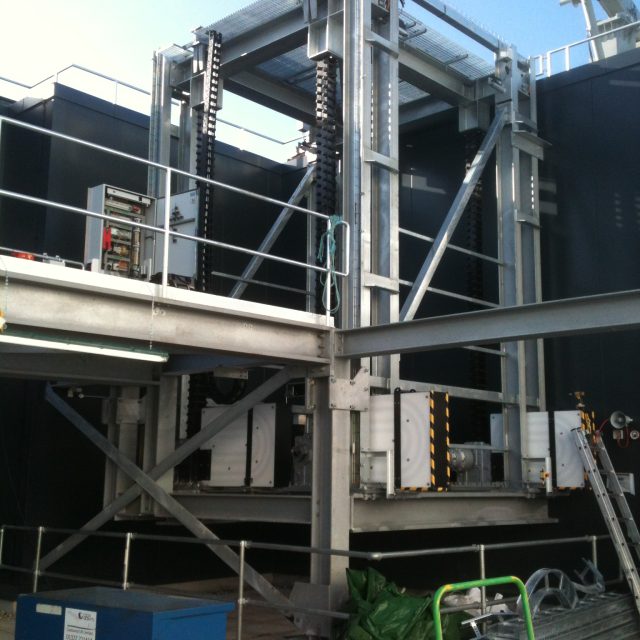
Modernisation is the biggest opportunity here
Most enquiries from this sector arrive because something has broken and broken again. An ageing hydraulic goods lift in a hot building is a recurring cost: fluid, seals, cooling, and a shaft that has to be entered to service it. Rigid chain is a direct replacement for an existing hydraulic or traction system, and in the process it removes the borehole, the fluid, the machine room and the cooling — while the shallow pit means the existing pit is very often already deep enough.
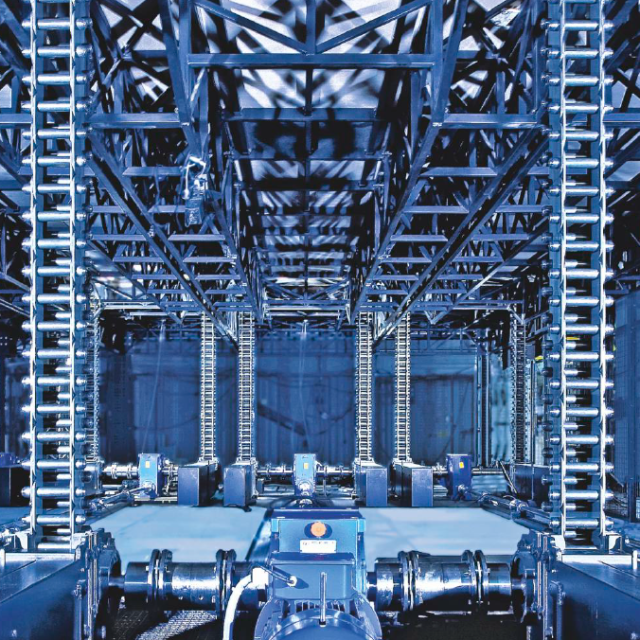
Where the load sits does not matter
Industrial loading is rarely tidy. A single heavy casting, a part-loaded pallet or an off-centre coil produces an eccentric load, and on a conventional system that means differential movement and a correction cycle. Here the interlocked chain columns do not deflect differentially, so landing accuracy is unaffected by how the load was placed — which is what makes a forklift-loaded goods lift reliable rather than approximately reliable.
Frequently asked questions
The standard goods lift range reaches 25,000 kg. Above that, truck lifts continue to 60,000 kg, and bespoke systems are engineered beyond the catalogue.
The technology is specified for harsh environments and extreme temperatures with no cooling or heating plant required. There is no hydraulic fluid to degrade and no pressurised lines to route through the heat.
Yes — it is a direct replacement in modernisation, and it removes the borehole, the fluid, the machine room and the cooling in the process. The existing pit is frequently already deep enough.
No. Eccentric loading produces no differential movement between the chain columns, so the car lands accurately regardless of how the load was placed on the platform.
No limit on starts and stops per hour, and no heat-removal system is required even at sustained high duty.
Discuss your heavy industry lift project
Plant engineers, maintenance managers and heavy industry facilities leads: our engineering team supports specification, retrofit and modernisation.