
Use Case
Infrastructure
Public infrastructure judges a lift on one thing above all others: availability. A station lift out of service is a station that is not step-free. A hospital goods lift down is a ward without supplies. A data centre lift that needs a shutdown to service is a lift that will never be serviced properly.
None of these assets can close while the lift is repaired — or, usually, while it is installed. That is why the specification here favours a purely mechanical drive requiring minimal maintenance and no machine room over anything faster, cheaper or more sophisticated.
Railway
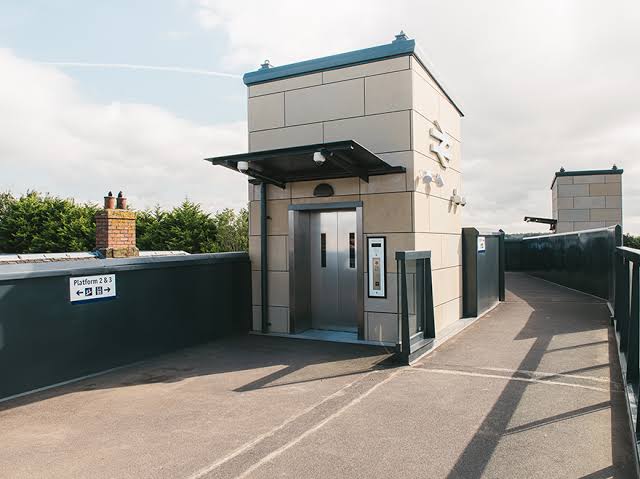
This is the strongest evidence in the section. In 2020, a major player in the railway operator industry, asked SERAPID for safe, reliable access to the rail network for all passengers. SERAPID was a heavy-duty lift specialist; what came back was a new passenger lift product line built on rigid chain, carrying 1,250 kg at 0.63 m/s.
The detail that matters most to an operator is the second duty. A reduced emergency mode of 450 kg at 0.38 m/s was specified so that after a component failure the lift keeps bringing passengers to the platform. That is the difference between a degraded service and a closed station.
The lift was designed for the conditions that defeat conventional station lifts — heavy and ungentle use, near-outdoor exposure, and a long distance from a maintenance depot. Its modular construction and compact mechanical drive make retrofit into existing shafts practical across the very wide variety of platform arrangements a national network contains.
Airports
Airports concentrate every difficult lift requirement into one asset: continuous operation, heavy baggage and ground equipment movement, security-driven separation between landside and airside, and no tolerance for unplanned closure. Goods lifts, truck lifts serving apron and basement levels, and passenger lifts retrofitted into live terminals are all in range — and the absence of a machine room matters more in a terminal than almost anywhere else, because every square metre is either retail or circulation.
Stadiums and arenas
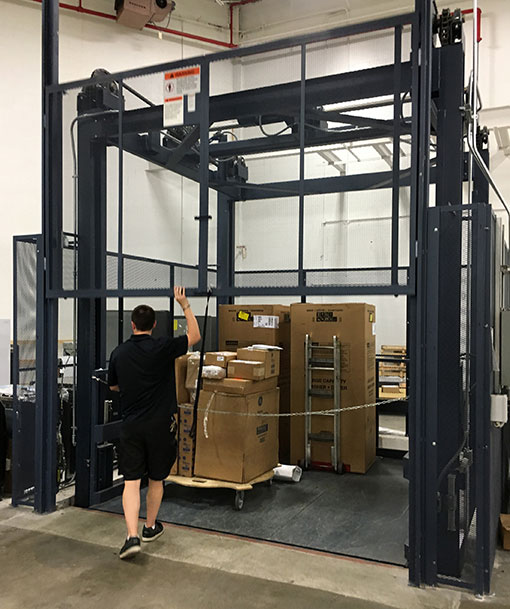
Stadium lift briefs look more like venue briefs than public building ones: heavy equipment, catering and waste movement on event days, vehicle access to pitch or concourse level, and a duty profile of extreme peaks separated by near-total idleness. Truck and goods lifts cover most of it, and the peak-day duty is where a system with no limit on starts per hour distinguishes itself.
Data centres
An emerging application with a very specific profile. Equipment is heavy and getting heavier as rack density rises, floor loading is critical, hydraulic fluid anywhere near the white space is unacceptable, and heat rejection from any mechanism is a direct operating cost because it has to be removed again. A lift generating almost no heat, containing no fluid and needing no machine room answers all three at once.
Hospitals
Hospital briefs centre on heavy, awkward movement — imaging equipment, sterile supply, catering, waste — in a building that cannot shut down, where noise carries into clinical areas and where hydraulic fluid is unwelcome. Goods lifts and goods-and-passenger lifts in accessible configurations cover the requirement, and the retrofit advantages apply as they do in any occupied building.
The common thread
| Infrastructure requirement | How a rigid chain lift answers it |
| Cannot close for maintenance | Purely mechanical, minimal maintenance, 1 million cycle life |
| Cannot close for installation either | No machine room, no borehole, shallow pit, modular drive |
| Level landing every time | Millimetre positioning without re-levelling — critical for accessibility |
| Heavy and uneven loads | No differential movement; no compensation system to fail |
| Peak demand in bursts | No limit on starts per hour; no heat rejection to remove |
| Must degrade gracefully | Reduced-duty emergency modes can be specified |
| Floor area is revenue | No machine room returns plant space to use |
Frequently asked questions
Because station lifts fail on availability rather than capacity. A purely mechanical drive with minimal maintenance reduces downtime, and a reduced-duty emergency mode allows the lift to keep bringing passengers to the platform after a component failure.
Yes. The compact, modular, purely mechanical drive fits existing shafts with the building fabric practically unaffected in operation, which is what makes station-by-station upgrade programmes feasible.
1,250 kg at 0.63 m/s as the standard duty, with a reduced emergency duty of 450 kg at 0.38 m/s developed for a bespoke case.
Three reasons converge: no hydraulic fluid near the white space, almost no heat rejection to remove, and no machine room to find space for — while equipment loads keep rising with rack density.
Yes. Positioning is repeatable to the millimetre without re-levelling and is unaffected by load distribution — which for an accessibility lift is the specification that matters most.
Contact our engineering team
Infrastructure clients and operators, transport engineers, stadium operators, data centre design engineers and NHS estates: discuss your project with our engineering team.