
Use Case
Intralogistics & Automation
Automation punishes anything that needs attention. A lift running a few cycles a day can carry a maintenance schedule; a lift inside an automated flow cannot, because every intervention stops the system — and the entire justification for automating was that it would not stop.
This is the sector where the duty cycle argument does the most work. No limit on starts and stops per hour, no heat rejection requiring cooling, no pressurisation dwell before each movement, no hydraulic fluid to change, and no pump to service.
Automated car parks
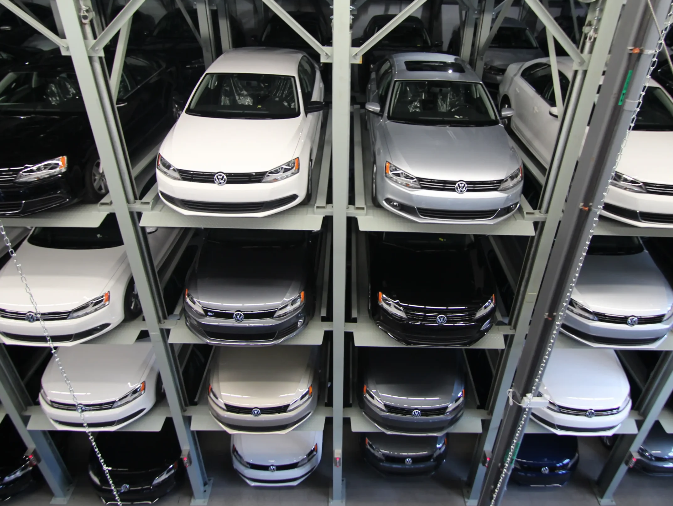
Automated parking exists because of two pressures: parking ratio requirements on new commercial buildings, and land values that make conventional garages uneconomic where height is also restricted. Because the vehicles are unoccupied, the storage envelope can be smaller and lower than a conventional garage — cars are stacked and shuffled as others arrive and leave.
The lift is the system’s bottleneck and its single point of failure. Early automated parking used cable drives, which were dirty, noisy and maintenance-intensive. SERAPID’s Vertical LinearBeam is entirely self-contained and installs as modular units, which lets a parking OEM configure a system rather than engineer one from scratch.
Warehouse and distribution applications
| Application | Lift type | Why it fits |
| Mezzanine and multi-level pick faces | Goods lift | High-frequency pallet and tote movement between levels |
| Automated storage and retrieval interfaces | Goods lift | Flush, repeatable landings for automated transfer |
| Goods-only platform duty | GA series | Machinery Directive route; shallowest pit and headroom |
| Operator-attended movement | GO series | Attended duty, limited to 0.15 m/s |
| Cross-dock and yard level changes | Truck lift | Loaded vehicles between yard and dock levels |
| Automated car parking | Vertical LinearBeam | Self-contained modular lift units |
Landing accuracy is what makes automation possible
For a manual operation, a lift that lands a few millimetres out is an irritation. For an automated one it is a fault condition — a shuttle, conveyor or AMR transferring across the threshold needs the floors to be coplanar every time, not most times.
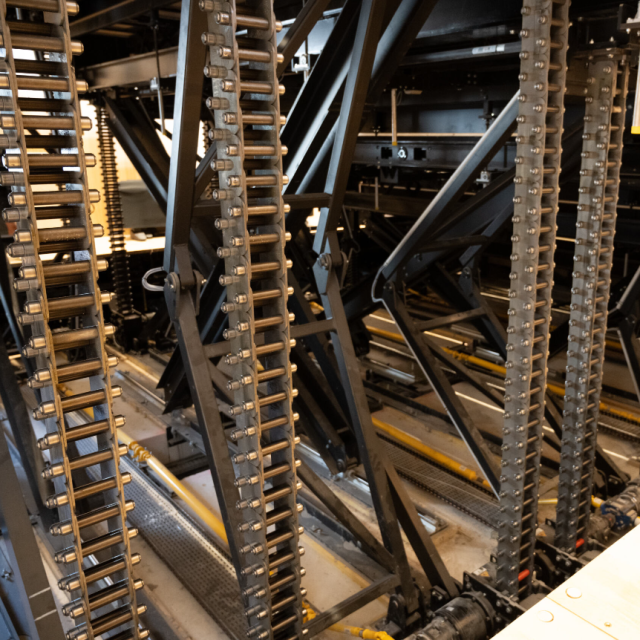
Rigid chain positions to the millimetre without re-levelling, and does so irrespective of how the load sits on the platform. A pallet loaded to one side produces no differential movement in the columns, so there is no correction to make and no compensation system whose drift becomes next year’s intermittent fault.
Availability arithmetic
The comparison an integrator should make is not capital cost. It is expected downtime across the system life — service visits, fluid changes, seal failures, and the throughput lost each time. A purely mechanical drive guaranteed to one million cycles, with no fluid and no pump, changes that calculation before speed is even discussed.
Frequently asked questions
There is no limit on starts and stops per hour, and the technology generates minimal heat, so continuous duty requires no cooling plant and no enforced rest period.
Yes. Positioning is repeatable to the millimetre without re-levelling, and is unaffected by uneven loading — which is what allows shuttles, conveyors and AMRs to transfer directly across the threshold.
Because the Vertical LinearBeam is self-contained and modular, so it installs as units rather than as an engineered one-off, and it replaces the cable drives that made earlier automated parking noisy and maintenance-intensive.
Minimal. There is no hydraulic fluid to change and no pump to service, and the system is guaranteed to one million cycles.
Usually the Machinery Directive 2006/42/EC or EN 81-31, which allow markedly shallower pits and reduced headroom than an EN 81-20 passenger-rated lift — often the difference between a lift fitting the building and not.
Contact our engineering team
Automation integrators and warehouse operations leads: discuss your lift specification with our engineering team.