
Use Case
Nuclear Lifts & Waste Container Elevators
Nuclear inverts the usual lift priorities. Speed is irrelevant. Duty is trivial — a system might run two hundred times a year. Capacity is often modest. What matters is that the lift works every time for the life of the plant, in a place where a repair is a project rather than a callout.
SERAPID has supplied linear motion to the nuclear industry for over fifty years, and its lift work in the sector follows the same logic as the rest: the compactness of the drive is what solves the problem.
When height is the constraint
In EPR plants, which SERAPID has supplied to, a nuclear-safety-compliant elevator to lift waste containers into storage cells is required for example. The binding constraint here is not the load — it is the height available. Because the rigid chain elevation system requires so little space, the platform can sit at ground level, which resolves the problem.
Data below is indicative only.
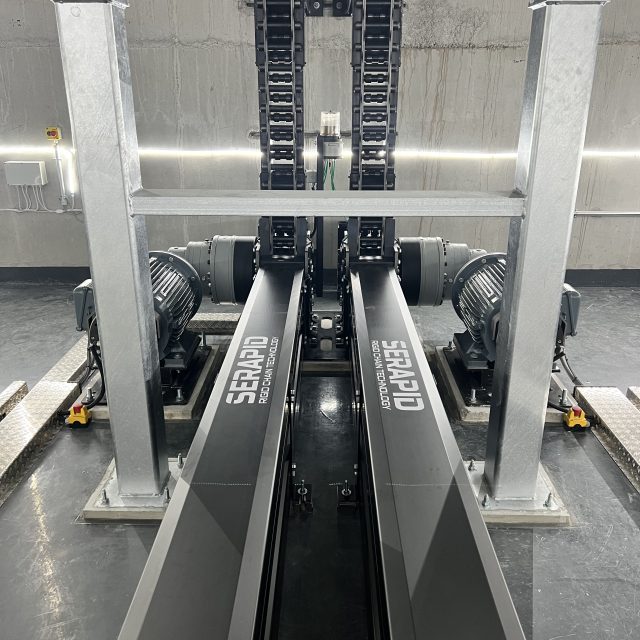
| Parameter | Value |
| Stroke | 3.6 m |
| Lifting force | 10,000 daN |
| Speed | 50 mm/s |
| Frequency | 200 cycles per year |
Two hundred cycles a year is worth pausing on. A lift installed today will still be in service long after the people who commissioned it have retired. Reliability and service life, not throughput, are the specification that matters — and SERAPID’s own note on the project is that the rigid chain’s reliability and long service life are major strengths for nuclear professionals, particularly for safety-related measures.
Why the technology qualifies for the sector
| Nuclear requirement | What rigid chain offers |
| No fluid in a controlled area | No hydraulics — and no fluid that could itself become contaminated waste |
| Minimal maintenance in a restricted zone | Purely mechanical, standard components, minimal service requirement |
| Plant-length service life | Guaranteed to 1 million cycles — decades at nuclear duty rates |
| Severe height or space constraint | Compact magazine; platform can sit at ground level |
| Corrosive or contaminated atmospheres | Stainless construction and chain treatments available |
| Very low duty, long dormancy | Nothing under standing pressure; no seals degrading between cycles |
| Non-standard compliance route | Established experience of certification via Notified Bodies |
Beyond waste handling
- Goods lifts serving controlled areas, where a machine room would be an additional zone to manage
- Equipment and component lifts within reactor and auxiliary buildings
- Decommissioning: temporary and permanent lifts installed into existing structures with minimal intervention
- Fuel and cask handling elevators where headroom is restricted
Decommissioning
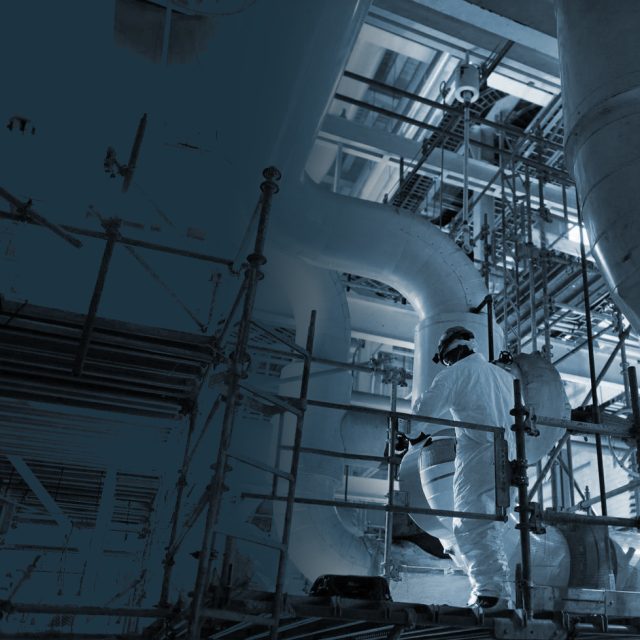
Decommissioning is the growth case and it plays directly to the technology’s strengths. The buildings were not designed for the equipment now needed in them, no one wants to introduce hydraulic fluid into a structure being taken apart, and installation must disturb the existing fabric as little as possible. A lift needing no machine room, no borehole and only a shallow pit is a markedly easier proposition than the alternatives.
Frequently asked questions
Because the drive requires so little space that the platform can sit at ground level. At Flamanville this was the specific constraint the technology was selected to resolve.
Twice over. There is the leak path into a controlled area, and there is the fact that the fluid itself can become contaminated waste requiring management and disposal. An electromechanical lift removes both.
Systems are guaranteed to one million cycles. At nuclear duty rates — often a few hundred cycles a year — that is a service life measured against the plant rather than against the equipment.
It is well matched. No machine room, no borehole and a shallow pit mean minimal intervention in a structure being dismantled, and there is no fluid to introduce into it.
Discuss your nuclear lift project with SERAPID
Over fifty years of linear motion work in the nuclear sector, delivered by our engineering, installation and commissioning teams.