
Use Case
Aerospace & Space
Aerospace components break the assumptions goods lifts are built on. They are large in one dimension and light for their size, they are worth more than the building they are moving through, and the tolerance for contamination, impact or a stalled load somewhere between two floors is effectively zero.
Capacity is rarely the constraint. Car geometry, cleanliness and absolute reliability are.
Aerospace Lift Requirements
| Requirement | How rigid chain answers it |
| Oversized, awkward car dimensions | Standard cars to 25 t and 97 m²; bespoke geometry beyond that |
| No contamination risk | Purely electromechanical — no hydraulic fluid anywhere in the system |
| Flush, repeatable landings | Millimetre positioning without re-levelling, whatever the load distribution |
| No dust or heat into a clean hall | No pump, no heat rejection, no cooling plant |
| Uneven load on a large platform | No differential movement; no compensation system to fail |
| Retrofit into an existing facility | No machine room, no borehole, shallow pit |
Where a lift appears in a facility
- Component movement between floors of a manufacturing hall or subassembly building
- Tooling and jig transfer between storage and assembly levels
- MRO hangars with basement or mezzanine stores serving the hangar floor
- Ground support equipment between levels in maintenance facilities
- Vehicle and equipment lifts serving elevated or sunken working areas
Why oil-free is a different argument here
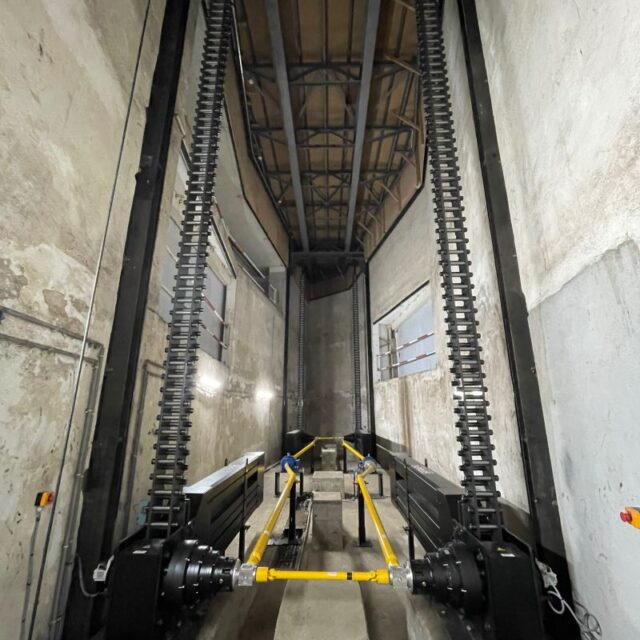
In most sectors, eliminating hydraulic fluid is an environmental and maintenance argument. In aerospace it is a contamination argument, and the cost of the consequence is not the cleanup — it is the component and the schedule. A composite structure, an engine module or an assembled avionics rack does not tolerate a leak, and a lift shaft passing through a controlled environment is exactly the kind of route where one would not be noticed until too late.
Space and launch facilities
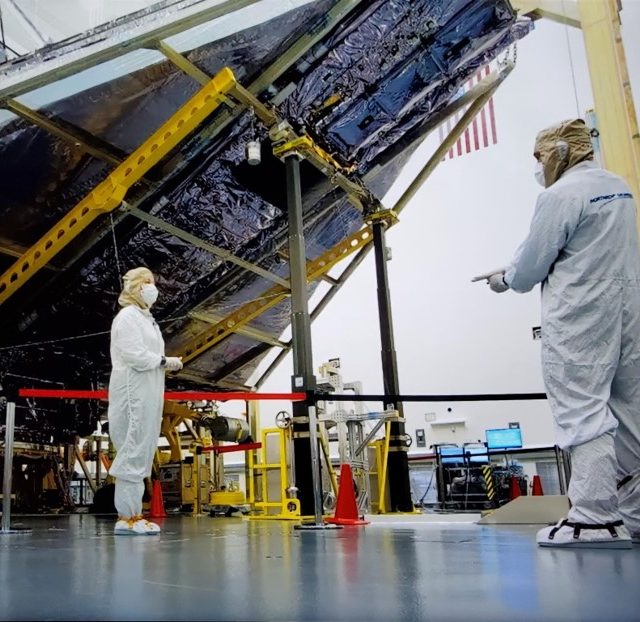
Integration and launch facilities present the same profile amplified: very large components, very high value, very low duty cycles, and a strong preference for mechanical simplicity in equipment that must work on the day.
Frequently asked questions
Yes. The standard range reaches 25,000 kg with car areas up to 97 m², and beyond that cars are engineered to the component rather than the catalogue — dimension is usually the driver in this sector, not weight.
No. The drive is purely electromechanical and contains no hydraulic fluid, which removes the leak path entirely — the reason the technology is also specified in nuclear and pharmaceutical environments.
Yes. Positioning is repeatable to the millimetre without re-levelling and is unaffected by how the load sits on the platform, so transfer across the threshold is consistent.
Yes. No machine room and no borehole are required, and the shallow pit and compact drive make retrofit into an operating facility considerably less disruptive than the alternatives.
Discuss your aerospace lift project with SERAPID
Our engineering team supports aerospace facilities engineers, manufacturing leads and MRO operations from concept to commissioning.