
Use Case
Automotive Industry
Automotive plants are among the most vertically constrained industrial buildings there are. Presses, paint, and body-in-white consume the floor plate; mezzanines and multi-storey logistics buildings absorb the overflow; and everything that moves between those levels moves constantly, on a takt time that does not pause for a lift.
Where lifts sit in an automotive facility
| Location | Lift type | What it has to do |
| Plant mezzanines and multi-level lines | Goods lift | Components and containers between production levels at high frequency |
| Tooling and die stores | Goods lift | Multi-tonne tooling between storage levels — 10–25 t range |
| Logistics and distribution buildings | Truck lift | Loaded vehicles between yard and dock levels without a ramp |
| End of line and finished vehicle storage | Car lift | Vehicles between levels of a multi-storey compound |
| Test facilities and workshops | Car / truck lift | Vehicles to elevated or sunken test and inspection levels |
| Showrooms and dealerships | Car lift | Display vehicles between floors, in a public-facing finish |
Duty cycle is the differentiator
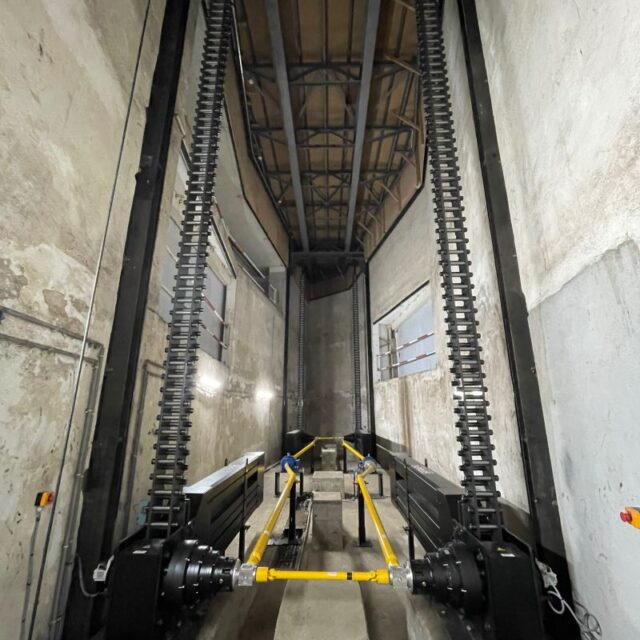
A plant lift is not judged on speed. It is judged on whether it is available on the next takt, every takt, through three shifts. Rigid Chain Technology has no limit on starts and stops per hour and generates minimal heat, so sustained high-frequency duty requires no cooling plant and imposes no rest period. There is no pressurisation dwell before each movement, which on a short travel between two mezzanine levels is a meaningful share of the total cycle time.
Why plants stop specifying hydraulic
- No hydraulic fluid in a building with paint, solvents and a fire strategy already under pressure
- No borehole, which matters where ground conditions or existing slabs rule one out
- No machine room, returning floor area to production
- Loads resolve into the foundations rather than into a structure already carrying heavy process equipment
- Landing accuracy without re-levelling, so automated handling can transfer directly across the threshold
- Eccentric loads — an off-centre container or a single heavy die — cause no differential movement
Finished vehicle movement
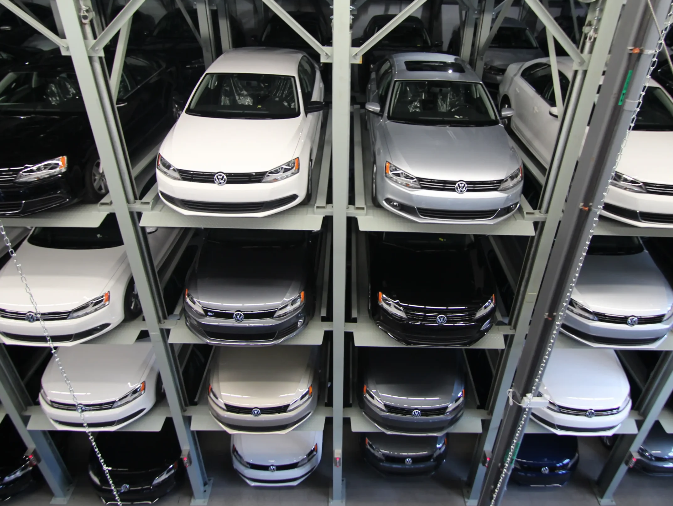
At the end of the process the same technology handles the product itself. Car lifts in the standard range cover 2,500 kg to 5,000 kg, which spans passenger vehicles and light commercials; heavier vehicles move to the truck lift range. In multi-storey finished-vehicle compounds and in automated storage, the argument is the same one urban developers make — a lift occupies roughly one bay, where a ramp consumes more area than the parking it serves.
Frequently asked questions
Yes. There is no limit on starts and stops per hour, no cooling plant is required at sustained duty, and there is no pressurisation dwell before movement — which on short inter-mezzanine travel is a significant proportion of cycle time.
Typically in the 10,000 kg to 25,000 kg part of the goods lift range, though this depends entirely on the tooling. Note that transferring dies into presses is a separate discipline covered by the QDX range, not by a lift.
They introduce fluid into a building with an already demanding fire strategy, require a borehole, and need a machine room. An electromechanical lift removes all three, which is often decisive on a constrained site.
Yes. A truck lift carries the loaded vehicle between yard and dock levels in roughly the footprint of the vehicle, where a ramp of equivalent function consumes a substantial part of the plot.
Yes, but that is press automation rather than a lift — push/pull systems, transfer tables, die carts and stackers. See the QDX range.
Discuss your automotive plant lift with SERAPID
Our engineering team supports plant engineers, manufacturing facilities leads, automotive logistics managers and dealership developers from concept to commissioning.