
Use Case
Entertainment & Art
Everything that appears on stage has to get there first, and the route is rarely kind. Scenery arrives on a lorry, at street level, in a building whose stage sits a storey above or below — often a listed building on a constrained urban site with no room for a ramp and no tolerance for a machine room.
The get-in lift is therefore one of the most demanding installations in a venue. It carries very heavy, very awkward loads, it is used intensively for a few days between productions and then barely at all, and it cannot fail during a get-in because the schedule has no slack in it.
From the Street to the Stage
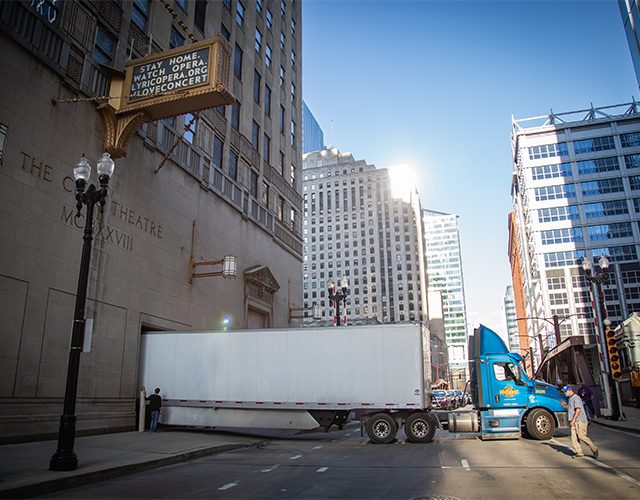
At Lyric Opera of Chicago, a rigid chain system drives a scenery lift running from street level to stage and up to the rehearsal room — three discrete landings. The platform is around 58 feet long, the chain is stored in seven cassettes, and the lift was rated for 80,000 lb, because the venue occasionally has to raise a fully loaded broadcast truck.
That is a truck lift in everything but name, installed inside an opera house. It is a useful illustration of why the venue market sits with the heavy-duty range rather than with conventional goods lifts.
Which lift for which venue problem
| Requirement | Lift type | Why |
|---|---|---|
| Vehicle access to stage or dock level | Truck lift | 10–60 t; carries the lorry rather than unloading it first |
| Scenery and equipment between levels | Goods lift | 1.5–25 t; goods-only or attended configurations |
| Get-in with crew travelling | Goods attended | Operator rides with the load; limited to 0.15 m/s |
| Museum and gallery collection movement | Goods lift | Oversized car, fine positioning, no hydraulic fluid |
| Public and accessible circulation | Passenger lift | EN 81-20 / EN 81-41 routes for visitor access |
| Anything the building will not permit | Bespoke | Heritage venues rarely accept a standard product |
Museums, galleries and collections
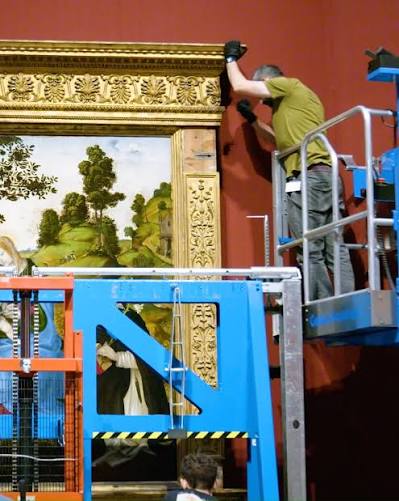
Art handling changes the priorities. The load is light but the consequence of a fault is unbounded, and the objects are frequently oversized in one dimension — which drives car geometry rather than capacity. Two properties matter disproportionately here: there is no hydraulic fluid anywhere in the system, so there is no leak path into a space holding irreplaceable objects; and positioning at each landing is repeatable to the millimetre without re-levelling, so a crated work crosses a flush threshold rather than a step.
Heritage venues and the compliance problem
Many European venues are listed, and a listed building will not usually accept a borehole, a machine room or new loads at high level. SERAPID Lift Systems has extensive experience of installations where full compliance with the standard is physically impossible, working with Notified Bodies and producing detailed design files supported by essential health and safety requirements to achieve certification another way. In heritage venue work, that capability is often the whole reason a scheme proceeds.
Duty pattern: intense, then idle
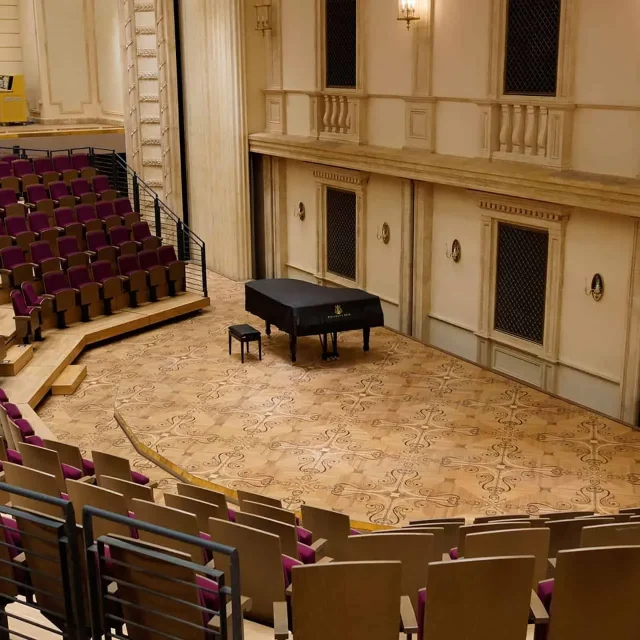
A get-in lift’s duty is unusual — heavy continuous use for two days, then very little for six weeks. That pattern is hard on hydraulic systems, which sit under standing load between uses and need pressurisation before every movement. A purely mechanical drive has nothing degrading in the interval and no dwell before it moves.
Frequently asked questions
Yes. Truck lifts in the standard range run from 10,000 kg to 60,000 kg, and venue installations exist where a fully loaded vehicle is raised from street level to stage or dock level rather than unloaded outside.
No. Those are continuous-travel stage platforms rather than lifts serving discrete landings, and they are covered in the Stage Systems section — though they use the same underlying rigid chain technology.
Frequently yes, where other technologies cannot. No machine room, no borehole and a shallow pit mean far less intervention in the historic fabric, and there is established experience of achieving certification with Notified Bodies where full compliance is impossible.
Two reasons above all: there is no hydraulic fluid to leak near the collection, and landing accuracy is repeatable to the millimetre without re-levelling, so crated works cross a flush threshold every time.
Nothing degrades. There is no fluid under standing load and no pressurisation cycle, so the intermittent duty typical of venue get-ins costs nothing in reliability.
Discuss your venue lift project with SERAPID
Our engineering team supports theatre consultants, venue technical directors, museum facilities leads and architects from concept to commissioning.